- Meerac's Newsletter
- Posts
- Unveiling the Phygital Collectibles Ecosystem: From Tokenization to DeFi Integrations and Beyond
Unveiling the Phygital Collectibles Ecosystem: From Tokenization to DeFi Integrations and Beyond

meerac
July 25, 2023
In an era where technology intertwines with our daily lives, an ecosystem has emerged, bridging the gap between physical collectibles and digital ownership: The world of Phygital Collectibles.
This vibrant ecosystem represents a blend of blockchain's interoperability, transparency, and innovation with tangible real-world assets. The vitality and successful operation of this ecosystem hinges on the smooth interaction among a multitude of crucial stakeholders: tokenization protocols, issuers, service providers, verifiers, custody providers, DeFi platforms, and data analytics tools. Each plays a critical role in nurturing a safe, reliable, and fruitful environment for phygital collectibles to thrive.
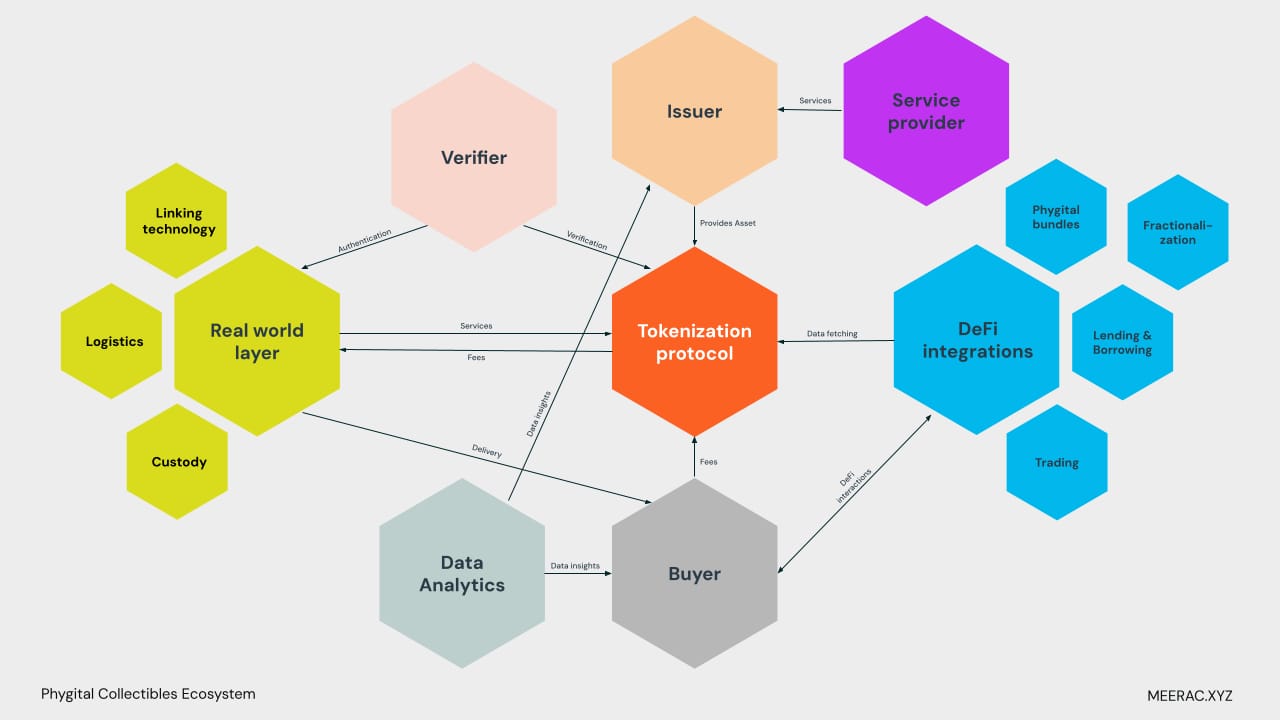
Today, we'll walk you through this exciting terrain and the integral parts that make it tick.
The Heart of the Ecosystem: Tokenization Protocols
Tokenisation protocols, such as 4k.com, courtyard.io, and blockbar.com are at the core of this ecosystem. These platforms provide the infrastructure that enables issuers to tokenize their assets, utilize and maintain collectibles on-chain, and facilitate redemption of the physical collectible.
The Birth of a Phygital Collectible: Issuance and Verification
The lifecycle of a phygital collectible begins when a seller or issuer, for example, a luxury watchmaker, decides to tokenize a watch collection. Often, they collaborate with a service provider firm to receive guidance on tokenization, selecting an appropriate protocol and blockchain, and ensuring a smooth development process.
The next step involves the physical asset - in this case, the watches. They are sent in for authenticity and condition checks, performed either by the tokenization protocol or a third-party verifier. This procedure ensures the integrity of the physical asset and is repeated periodically after the collectible is vaulted to check on the asset's existence and condition.
Real World Layer: Custody, Linking Technology, and Logistics
Once verified, the watches are securely stored in a vault by a custody provider like brinks.com. Linking technology, provided by firms like Meta Anchor, is often employed to tamper-proof the connection between the physical asset and its NFT.
To enhance trust, custody providers typically need to stake assets in the protocol that are slashed if misconduct occurs (e.g., unauthorized disposal of the asset.). Plus, the physical asset is usually insured when it enters the vault.
The custodians, sometimes also called guardians, take a fee for storing the watch. The NFT holder typically pays these fees monthly or yearly via the protocol with stablecoins. If a holder fails to pay within a certain amount of time, the watch will be auctioned off to pay for the occurred costs.
Phygital Collectibles Unleashed: Social showcasing, DeFi integrations and Redemption
With the physical watch securely stored and authenticated, the corresponding NFT or 'digital twin' is minted. An interested buyer can then trade the watch on an NFT marketplace. The tokenization protocol itself may run these trading venues, and/or the watch is listed on traditional marketplaces like OpenSea and/or LooksRare.
Once a buyer owns an NFT, they can show their watch on web3 socials, use it in DeFi applications or redeem the NFT for the physical good.
Socials - On web3 social protocols like lens.xyz the watch would (if on the same chain) directly show up in the profile of the new owner.
DeFi - There are several options on how a buyer can utilize the watch in DeFi applications. It can be used as collateral for a loan on DeFi platforms like Arcade.xyz. Fractionalization platforms like Tessera.co allow the owner to fractionalize the NFT into several parts to sell pieces of the phygital asset. It's also possible to bundle these types of phygital NFTs to offer baskets of collectibles as a new financial product. Several other DeFi use cases are currently in development.
Redemption - If the owner wishes to redeem their watch, they simply need to burn the NFT via the tokenization protocol. Afterward, the physical collectible is delivered to their doorstep. Most providers offer delivery to most parts of the world.
Data Analytics: Meerac and the Future of Phygital Assets
The final component in the phygital ecosystem comes in the form of data analytics providers like Meerac.xyz. Meerac tackles the fragmentation in the phygital landscape by tracking and analyzing collectibles assets on-chain. It gives issuers actionable insights to make informed decisions, monitor their assets' performance, and create meaningful community experiences. Meerac tracks a wide range of assets, including trading cards, sneakers, luxury goods, watches, and more, across various phygital marketplaces, and protocols.
Conclusion
The phygital collectibles ecosystem is a dynamic and exciting world that combines tangible assets and digital innovations. By merging blockchain's unparalleled interoperability, transparency, and security with the allure of real-world objects, it promises an exciting new frontier in collectibles trading, financialization, and management.
However, despite its current dynamism, there is much more to be built in this emerging field. We've only just begun to unlock its potential, and as we delve deeper into this landscape, we're likely to discover an array of new possibilities and applications. The journey to fully develop and optimize the phygital collectibles ecosystem is still underway, and we can anticipate an exciting road of exploration and innovation ahead.